

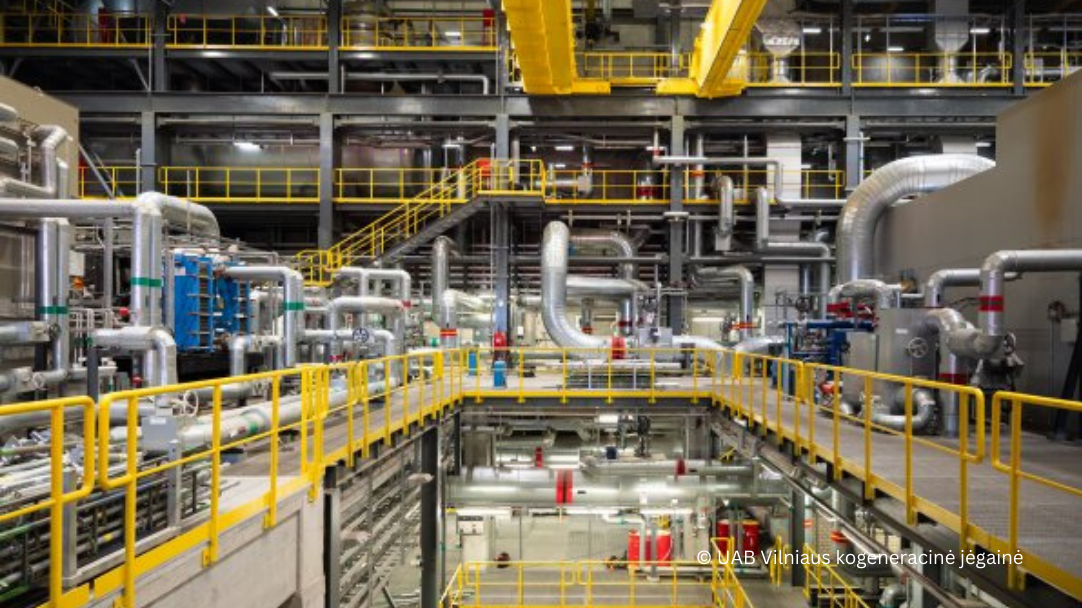
UAB Axioma Servisas, which has the largest portfolio of engineering services in Lithuania, continues to successfully cooperate with the country’s energy companies. At the end of last year, the company signed a new service contract with one of the most modern power plants in Europe – Vilnius Cogeneration Power Plant (VKJ).
Under the three-year contract, the Axioma Servisas Pump and Rotary Equipment Repair Department team will be responsible for the maintenance of the entire VKJ hydraulic system.
Comprehensive hydraulic system maintenance
Under the contract, Axioma Servisas has undertaken to perform both maintenance and repair work. Inspections of hydraulic equipment, connecting pipes, and other system components will be carried out, and system parameters such as pressure, flow, and vibration will be measured and adjusted. Worn components and operating fluids will also be replaced.
In addition, the supply of spare parts and materials is planned: air, pressure, and discharge filters, pressure sensors, manometers, magnetic valves, hydraulic cylinders, lubricants, and other necessary items.
All services will be provided as needed and according to orders submitted by the customer. The total value of the service contract is 400 K.
We have been providing services since the start of operations
Axioma Servisas has been servicing the equipment of the Vilnius cogeneration power plant since the start of operations in 2020.
“The main hydraulic system maintenance work is carried out during power plant shutdowns, when complex solutions requiring specific knowledge need to be implemented within a very limited time frame. Our specialists are very familiar with the facility, so we are ready for the smooth implementation of the contract,” says Vaidas Seniūnas, representative of Axioma Servisas.
About the Vilnius cogeneration power plant
The Vilnius cogeneration power plant can cover up to 50% of the capital’s centralized heating needs and produce enough electricity to power around 230,000–300,000 households.
The power plant uses municipal waste that is unsuitable for recycling after sorting, as well as local renewable energy sources – biofuel. The waste unit has an electrical capacity of up to 20 MW and a thermal capacity of up to 70 MW. The biofuel unit has an electrical capacity of up to 80 MW and a thermal capacity of up to 175 MW.
Each year, this cogeneration plant converts up to 200,000 tons of non-recyclable municipal waste into heat and electricity, which is equivalent to the volume of approximately 80 Olympic swimming pools.